
The 50-share NSE Nifty too rose by 20.35 points, or 0.19 per cent, to end at 10,908.70.

The Reserve Bank of India's (RBI's) latest order on unsecured loans is set to hit the banking sector's growth in the near-term, cautioned analysts, as they see banks slowing down on aggressive retail lending. Besides, cost of funds for non-banking finance companies (NBFC) is expected to inch up as banks will pass on higher capital charge to NBFCs. "We believe the fallout of the RBI action will be mainly on growth, given the rising dependence on unsecured retail loans and lending to NBFCs for growth.

US Federal Reserve Chairman Ben S Bernanke held talks with RBI Governor Duvvuri Subbarao in Mumbai.

The spike in volatility may not have impacted equity inflows, but it has weighed on new investors coming via the systematic investment plan (SIP) route. In May, 1.97 million new SIPs got registered - nearly 15 per cent lower than the previous five-month average of 2.3 million - reveals the data provided by the Association of Mutual Funds in India. Since June 2021, new SIP registrations have been upwards of 2 million each calendar month. The new SIP tally in May was the lowest in 12 months.

The S&P BSE Sensex gained 57 points to end at 26,064.

Waves of foreign portfolio investments worth over Rs 51,000 crore splashed into the Indian market in 2021 as overseas investors turned net buyers of domestic securities for the third straight year while excess global liquidity and other factors steered the ebb and flow of their investing ways. With the global financial system still flush with liquidity, emerging market assets, especially equities, might well remain the preferred investment avenue for many more months to come, experts opined. As the equities sizzled during most of 2021, that also saw economy slowly coming back into the recovery path, Foreign Portfolio Investors (FPIs) turned net buyers but their investment is much less compared to net inflows of Rs 1.03 lakh crore in 2020.

Reflecting nervousness over the prospect of the Federal Reserve tightening policy and event risk, traders stayed on the sidelines

The Indian financial services space seems to be in a sweet spot as foreign investors have made a net investment of Rs 14,205 crore ($2.1 billion) in the sector in November amid strong credit growth and manageable non-performing loan portfolio. The investment comes following a net withdrawal of Rs 4,686 crore from financial services stocks in October on account of profit booking. Overall, foreign portfolio investors (FPIs) have made a net investment of Rs 36,238 crore in the country's equity markets in November.

IndusInd Bank was the top loser in the Sensex pack, shedding around 3 per cent, followed by Dr Reddy's, NTPC, Maruti, Axis Bank, Bajaj Auto, Bharti Airtel and HDFC. NSE Nifty declined 76.15 points to 15,691.40.

'We will see a lot of investments from the private sector.' 'As long as we are not impacted by some global events, I think we will be in a strong place.'

'New record for the Nifty50 is only a question of when.'
Emerging markets like India and China are witnessing a remarkable transformation, despite a slowdown in economic growth, lifting millions of people out of poverty, Federal Reserve Chairman Ben Bernanke has said.

BSE benchmark Sensex nursed losses on Friday as investors pocketed gains after a five-session winning streak amid a bearish trend overseas. A depreciating rupee and foreign fund outflows further soured risk sentiment, traders said. The 30-share gauge, which had started the trade on a firm note, soon gave up all the gains and finally ended 651.85 points or 1.08 per cent lower at 59,646.15. The broader NSE Nifty snapped its eight-day rally to close at 17,758.45, down 198.05 points or 1.10 per cent.

The sharp correction in equity markets has taken a toll on mid-and-small cap stocks that have underperformed their large-cap peers. Thus far in calendar year 2022 (CY22), the mid-and-small cap indexes on the BSE have slipped over 8 per cent and 7 per cent respectively, as compared to a fall of around 6 per cent in the S&P BSE Sensex. While investors dumped mid-and small-cap stocks as the markets remained choppy over the past few weeks, analysts still expect these two segments to see good investor interest from a medium-to-long term perspective.

Equity markets will look for directions from global trends, ongoing quarterly earnings and investment patterns of foreign institutional investors (FIIs) in a holiday-shortened week ahead and may encounter volatility amid the scheduled monthly derivatives expiry, according to analysts. Equity markets will remain closed on Wednesday on account of 'Republic Day'. "This week is a holiday-shortened one and it's going to be critical due to the list of events and data that are lined up.
The impact of the Iraqi war on the US economy cannot be gauged until enough critical data relating to the period since the war's onset is available over the next several weeks, Federal Reserve policymakers said on Monday.

A United States federal appeals court in New York has reserved the decision in connection with the 1984 anti-Sikh riots case against Congress President Sonia Gandhi.

Indian markets on Thursday shrugged off any negative impact.

Bulls might be on the rampage on Dalal Street but lofty valuations of the Indian equities present a reason for concern and the markets could perhaps witness up to 10 per cent correction, according to analysts. Benchmark indices have been on a record-breaking rally lately and August witnessed the stock market reaching many new highs. The BSE benchmark soared over 9 per cent last month.

'Markets could face uncertainty in the short to medium term.' 'It would be prudent to invest in alternative asset classes, especially debt, for about a year.' 'Bank fixed deposits are offering rates as high as 9 per cent per annum and these can be used as a great hedging tool until equity markets stabilise.'

India's rupee is likely to remain under pressure due to high prices of crude oil and other commodities, and may stabilise at around 79-80 against the US dollar in the near term, say experts amid limited headroom available with the Reserve Bank to check the weakening of the domestic currency. The currency has slumped over 5 per cent this year after Russia's invasion of Ukraine sent international crude oil prices soaring to a decade high. On Monday, rupee ended at a fresh all-time low of 78.34 (provisional) against the US dollar.

This form of government, where secrets and major decisions are kept from the Cabinet itself, appears to be continuing, which is why the speculation around this special session, asserts Aakar Patel.

Equity benchmarks Sensex and Nifty halted their five-day rally on Tuesday and settled deep in the red, mirroring weak global markets, with decline in index heavyweights Reliance Industries, Infosys and HDFC Bank. Despite opening with gains of over 200 points, the 30-share Sensex turned highly volatile and tumbled 709.17 points or 1.26 per cent to close at 55,776.85. During the day, the benchmark index plunged 1,067.07 points or 1.88 per cent to 55,418.95. The broader NSE Nifty also declined 208.30 points or 1.23 per cent to close at 16,663.
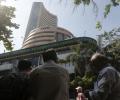
Rising for the fourth straight day, benchmark indices Sensex and Nifty settled marginally higher after a choppy session on Friday, tracking mixed global trends amid uncertainties on the geopolitical front. The BSE Sensex opened weak and declined 414.44 points to 55,049.95 in opening deals. But within minutes, it pared all its losses and jumped 369.56 points to 55,833.95. Facing volatility, the index finally settled at 55,550.30, higher by 85.91 points or 0.15 per cent.

'The Fed rate will peak in the range of 5.1-5.3 per cent during the second quarter of CY23 and will most likely stay there for a while before rate cuts start in CY24.'

As markets complete the first half of the calendar year 2022 (CY22) with a fall of around 9 per cent, the interest-rate hike trajectory by global central banks, paired with the conundrum of inflation and growth, will move the needle for the market, observe experts. Here's a quick rundown on what they'll react to over the next six months.

With the international markets facing uncertainty after Russia invaded Ukraine and Western nations retaliated with sanctions, Indian companies are putting their international fundraising plans on hold as they wait for the markets to recover. Bankers said apart from the geopolitical crisis, international rates are hardening in anticipation of interest rate hikes by the US Federal Reserve to control rising prices in the US. The Ukraine situation has implications for the market. In such a situation, international investors try to shift to safe haven assets by exiting from emerging markets.
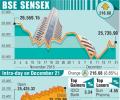
The S&P BSE Sensex surged 217 points to end at 25,736.
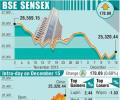
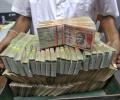
The rupee ended lower by six paise at 65.73 against the US dollar on Monday.

Six bills, including the one to amend the Jammu and Kashmir Reorganisation Act, were introduced in the Lok Sabha on Wednesday amid protests by opposition members over the violence in Manipur.

The hacking took place on the night of February 4.
A Pakistani court reserved its decision on Monday, on a petition filed by authorities to challenge an anti-terrorism court's order rejecting a plea to declare Ajmal Kasab and Fahim Ansari as fugitives. A Rawalpindi-based bench of the Lahore High Court comprising Justices Rauf Ahmed Sheikh and Hasan Raza Pasha reserved its decision after hearing arguments by the counsel for the Federal Investigation Agency, which had filed the petition on April 10.

'The idea is to invest where there is opportunity.'

Chasing a sixth US Open title, Federer needed just one hour and 46 minutes under a closed roof at Arthur Ashe Stadium to put away the 31st seed Lopez, leaving plenty in the tank after being forced to go the distance in his opening two matches.

Gold, the safest haven amid the ongoing uncertainty, also emerged as one of the most lucrative investment options in financial year 2022-23 with an impressive return of 16.1 per cent in rupee terms, and 2.3 per cent returns in dollars. And, had it not been for the very high inflow of smuggled gold and the huge discount prevailing in the market due to high prices, the returns in gold would have been much higher, analysts said. The precious metal has consistently been delivering positive returns in India since 2016.

Sentiments were also bearish largely in tandem with a sell-off in global markets as US Treasury yields surged to multi-year highs on robust economic data and comments from the Federal Reserve, sparking fears of accelerating inflation, brokers said.

There are already some signs of stress in this market.

If you don't have a specific goal, but want intermittent liquidity, then ladder your FDs, that is, invest in FDs of varying maturities, such as one, two, three, five or even 10 years. Laddering ensures FDs mature at regular intervals.
India Inc on Monday said that the Interim Budget was 'absolutely' up to the expectations.
 © 2026 Rediff.com - Advertise with us - Disclaimer - Privacy Policy - Sitemap - Feedback - About us - Terms of use - Grievances